
Three 2026 Knowledge Management Trends
Legal knowledge management is all set for a serious upgrade in 2026. The industry will see some exciting shifts in how lawyers work with knowledge management systems, partner with AI for quality assurance, and streamline workflows through seamless system integration and end-to-end task automation.
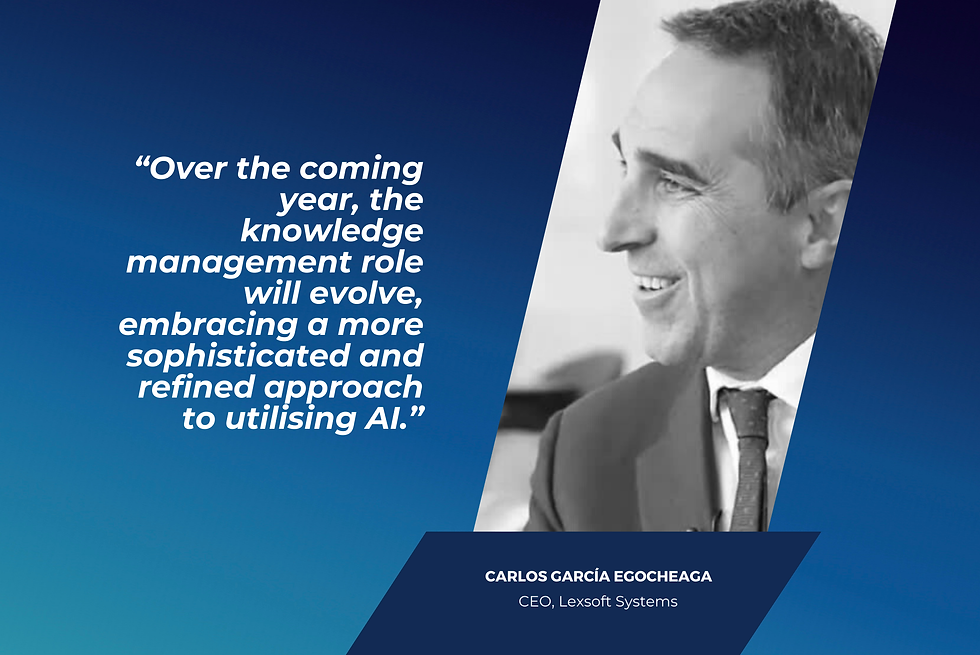
Over the coming year, the knowledge management role will evolve, embracing a more sophisticated and refined approach to utilising AI.
Conversational AI, knowledge search, and complete answers
Let’s be honest – today, lawyers are done with traditional keyword searches. The future belongs to conversational AI agents, such as Copilot, Claude, Gemini, or others, and in 2026, lawyers will use these as primary interfaces for interrogating and searching knowledge management systems, information repositories, and business platforms. Instead of hunting through knowledge management systems manually or by using standard keyword searches, lawyers will expect conversational AI interfaces to do the heavy lifting to surface information – right from understanding context, anticipating requirements, and autonomously coordinating information retrieval – to deliver complete answers or finished work, as opposed to mere search results.
This isn’t just a minor upgrade, but rather a near-complete reimagining of knowledge search. Instead of typing in search keywords and sifting through results, lawyers will throw complex, multi-layered queries in natural human language at AI agents who will then seamlessly execute the task – pulling information from across business systems and platforms to provide complete answers – sometimes even coordinating with multiple AI agents in the background.
Picture this: A lawyer commands, “Find me a Shares Purchase Agreement that has to do with China, and it has England as the jurisdiction. Use the Contract Management Software to create a new version of the agreement, populating it with data from the CRM system for Tim Jones. Then send a link to the contract via email to my assistant.”
This scenario depicts a vital shift – one instruction and the complete workflow is executed automatically. Knowledge search isn’t the endpoint anymore. In fact, it’s just the start of a series of automated task sequences.
The human touch is key
This doesn’t mean AI is taking over completely, but that a new AI-human collaboration model is becoming dominant. It’s more powerful than AI alone. This is how it will work: Generative AI will handle the exhaustive stuff, such as document classification and knowledge curation, managing metadata at a scale and speed humans can’t match. The professional support lawyers (PSLs) and knowledge professionals will play the essential role of quality guardians. They will critically review the AI product, catching errors, filling information gaps, and ensuring the knowledge management function meets enterprise standards and expectations.
The AI will provide the processing muscle while the knowledge professionals will provide the judgment and oversight.
Referring to the scenario above, if the documents extracted from the knowledge management system were from the "England and Wales" jurisdiction, the lawyer could ask the AI agent to only retrieve England jurisdiction documents. This level of accuracy can only work if the underlying document classification is detailed and verified. So, across this process, the AI gets the lawyers most of the way, and the humans make sure the task completion is bulletproof.
Connecting the dots with MCP for end-to-end task completion
Model Context Protocol (MCP) will emerge as a game-changer. Think of it as the critical glue that connects multiple AI agents to perform highly defined legal tasks, spanning everything from information retrieval to task completion. MCP will function as the default connector, allowing conversation AI tools to seamlessly integrate with a range of legal and enterprise systems – from contract management platforms, knowledge repositories, CRMs, practice management systems, and communication tools.
Consequently, MCP will transform legal workflows. Instead of lawyers manually moving through sequential workflow steps, the AI agents will execute entire task frameworks, end-to-end. Lawyers will describe complex, multi-step tasks in natural human language, and the AI agents will orchestrate the entire workflows end-to-end – searching across knowledge systems, pulling relevant precedents, synthesizing information from siloed business platforms, drafting customized documents, and delivering the final work product in the desired format.
Firms that adopt MCP-enabled agentic frameworks will gain a real competitive advantage. Their lawyers will spend less time on manual legal workflow steps and more time on strategic, client-focused legal activity that actually requires human expertise.
What this means for law firms
These three developments – conversational AI interfaces, integrated AI-human collaboration models, and the adoption of MCP – will restructure legal knowledge management and workflow execution for lawyers. Lawyers will be empowered to interact with information more naturally and intuitively, and automate complex processes routinely, while maintaining rigorous knowledge quality standards.
Lawyers will be able to make their search more efficient, speed up document review and drafting, and handle intricate, multi-step tasks with greater ease. By freeing up time previously spent on tedious data gathering and process coordination, they will be able to concentrate more on the uniquely human aspects of legal work that technology cannot replace.
Ends.
About the author
With over 30 years of experience in the technology sector, as CEO of Lexsoft, Carlos García-Egocheaga is responsible for driving the strategic direction and expansion of the overall business globally. He oversees all aspects of Lexsoft, including the P&L, HR, legal, and business development.



The shift toward AI-assisted quality assurance and end-to-end task automation feels especially practical for legal teams. Seamless system integration could make the evolving KM role far more strategic—I've been using https://wavespeed.pro
The shift toward AI-assisted quality assurance and end-to-end task automation feels especially timely for legal teams. I’m curious to see how these integrations work in practice—I've been using https://aisound.online/ai-sound-effect-generator-no-sign-up
The shift toward AI-assisted quality assurance and end-to-end automation feels especially relevant for legal teams. Seamless integration could make KM far more practical day to day—I've been using https://prisma3d.pro/prisma3d-vs-blender
The shift toward AI-assisted quality assurance and end-to-end task automation feels especially relevant for legal teams. Seamless system integration could make these trends practical—I've been using https://mageai.site/terms
The shift toward AI-assisted quality assurance and end-to-end task automation feels especially timely for legal teams. The evolving KM role is worth watching—I've been using https://image-to-3d-model-free.online/is-image-to-3d-model-free-safe